can be split into and .
Operations
- Addition follows the pattern. Two complex numbers are equal if their real and imaginary parts are equal ().
- Multiplication of Reals with Complex Numbers:
- Division:
- Conjugate: If then is its conjugate
- Reciprocal:
Notes
Radial coordinates are used for complex analysis. defines the argument of . Connecting the conjugate and magnitude of the complex number:
Euler’s Formula
Converts polar form back into cartesian:
Roots of Complex numbers
The collection of distinct complex numbers is
in which each of them have the property to equal when raised to the -th power. Such that all these complex numbers are the -th roots of . These are all distinct roots and there are many of them. The principal root where is given by
No Effect if
In the case where , both roots, ( and ) are equal. This is because is a positive integer (counter depends on it) and just results in differing the root by , which is the same as
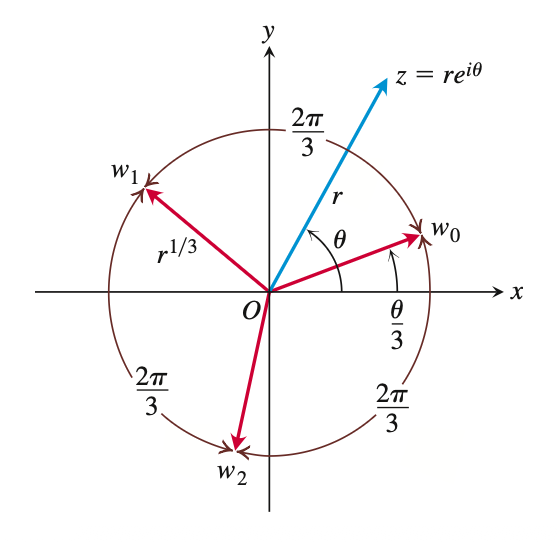
Roots in the Complex Plane
All nth roots of lie in a circle centered at the origin with radius equal to the real, positive, nth root of . One of them has argument the others are uniformly spaced around the circle with distance . The image shows the three cube roots of .