Linear Second-Order Differential Equations
Second order differential equations consist of second-order derivatives and require 2 initial conditions to be solved. Their typical structure is
If the equation will be considered homogenous.
Superposition Solution Principle
If it is true that the equation we’re dealing with is homogenous, the following Theorem holds.
If two linearly independent solutions (not constant multiples of eachother) of the differential equation and are known, then for any constants and the linear combination is also a solution to the equation. The Auxiliary Equation arises from that and provides solutions to the differential equation.
Nonhomogenous Linear Differential Equations
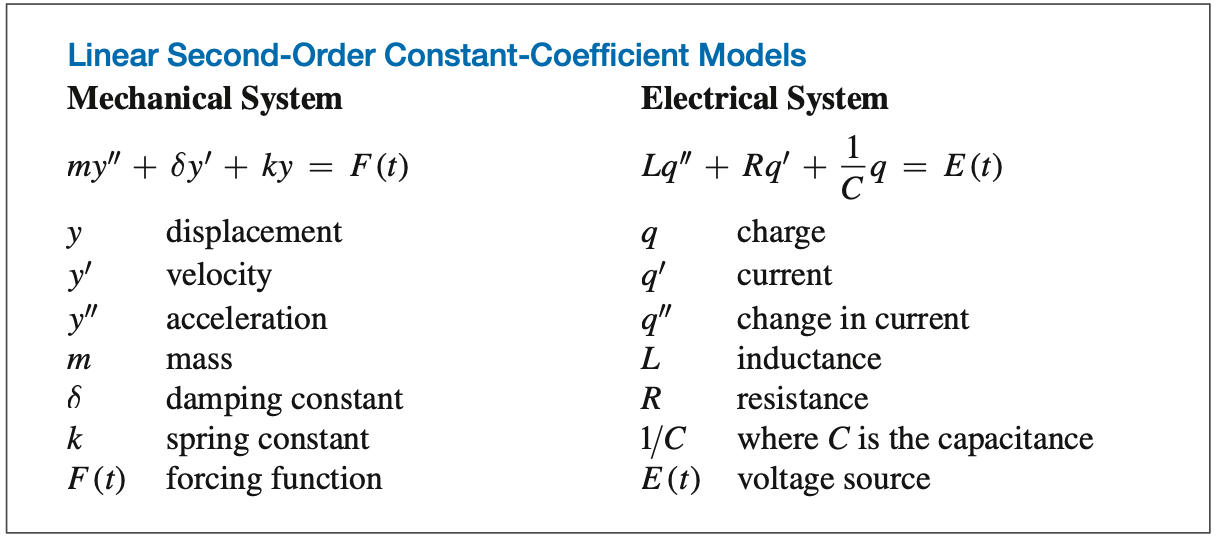
Analogies of Electrical Circuits and Mechanical Motion modeled by Differential Equations