Drift
For a charged particle in uniform mutually perpendicular electric field E and magnetic field B the average drift velocity with perpendicular direction to the fields and magnitude is
The two fields interacting causes circular Gyro Motion described in Influence of Electromagnetic Spaces on Charged Particle Motion. Over a full orbit of motion, these local accelerations average out to a drift directed perpendicular to the two fields being called a Drift.
Influence of Electromagnetic Spaces on Charged Particle Motion
A fundamental motion of charged particles inside a Magnetic Field is Gyro Motion. A charged particle moving in such a field, it experiences a force perpendicular to the direction of the Charge Motion and the field which is determined by the Right-Hand Rule. If moving in a curve, this force will cause positive Particles to gyrate anti-clockwise and negative Particles clockwise.
In the Visualization in which the Electric Field is pointed perpendicular to the Magnetic Field, instead of the negative particle moving away from, and the positive to the Electric Field, they move in a direction perpendicular to both of the fields. This is called the E cross B drift.
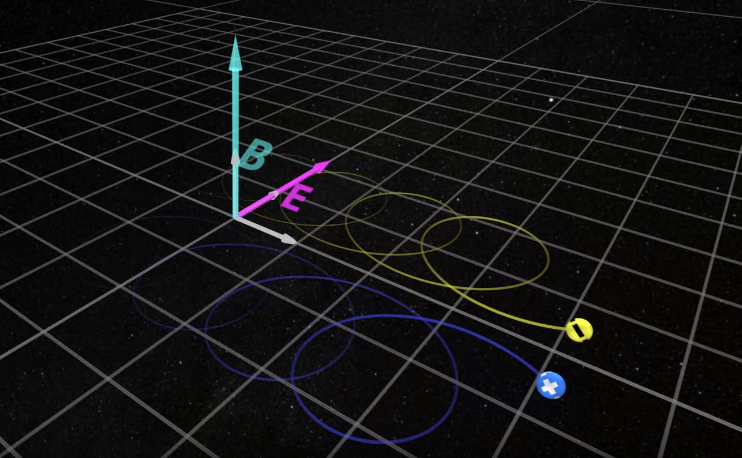 The cause for this unexpected drift in direction is the net effect of the both fields influence on the particles. As the magnetic field curves the particles path of motion, the electric field accelerates it, expanding the radius of magnetically-caused motion curvature up until a point where the positive particle moves in a direction opposite the magnetic field. When it reaches half of a “loop”, the electric field pulls the particle, shrinking its radius again. The net effect of these two field-caused behaviors is a net motion perpendicular to them both.
Derivation from the Lorentz force
In the Lorentz Force equation split velocity into the fast gyro-term and slow guiding-center velocity and average over the gyro orbit (setting average acceleration to 0)
Solving
(This is the unique velocity for which the electric field vanishes in the moving frame.)
Conditions
- E and B approximately uniform, scale larger than gyroradius, nonrelativistic, collisionless or weakly collisional, low-frequency slowly varying fields (guiding-center valid).
Article on the -Drift with Plasmapy
Particle of mass and charge in a constant, uniform Magnetic Field . Without external forces, it travels with velocity governed by equation of motion
which equates the net force on the particle to the corresponding Lorentz force.